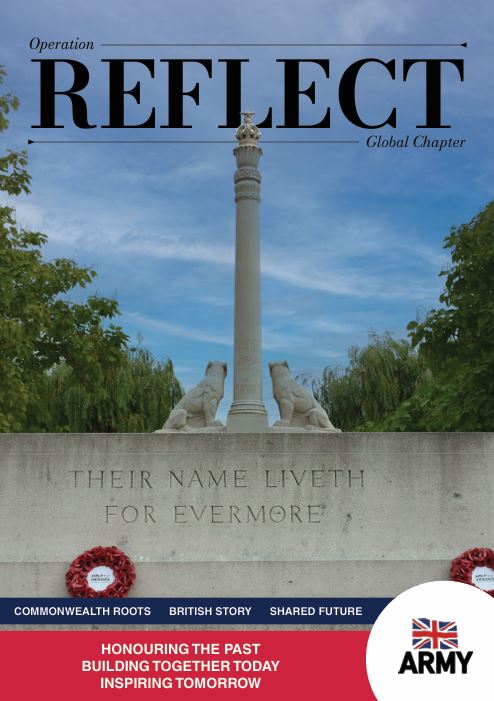
Originally published in the Operation Reflect Global Chapter 2026 – Official Publication
When it comes to our defence and security, we tend to discuss Britain’s resilience to hostile threats through what we can count; be they ships, aircraft, cyber capabilities, munitions or such things. All are essential for deterrence against malign state and non-state actors, which requires credible military power. Yet those capabilities can only be as strong as the society standing behind them.
A country may possess a sophisticated arsenal and yet still prove vulnerable if its people lose confidence in their institutions, in each other or in the idea that they share the same values and a shared future. Resilience should therefore be seen as a social condition to be built on trust, national identity and belonging.
Acts of Remembrance or Commemoration therefore matter beyond their ceremony, for they shape the stories a nation tells about itself and sows the narratives that bind its people together. In this way, the Commonwealth contribution to Britain should be considered as a strategic asset within Britain’s arsenal for national resilience.
Remembrance and commemoration are related but they are not the same. Remembrance is often personal and reflective, honouring those who served and asking us to consider what happened and why. Commemoration goes further, through memorials, exhibits, publications or battlefield visits, to ask what that history means now.
Remembrance preserves memory, while commemoration shapes identities. Every 11th November for Armistice Day our nation stops to remember those who fought and died for Britain, yet our people, drawn from diverse walks of life, are entitled to hold competing understandings of our past. To make it relevant, every community and each generation needs to understand why that history matters and where it fits within our own sense of being British.
For me, connecting to the past to find meaning in the present is personal. A third-generation British Sikh, I grew up in Birmingham at a time when my community had won the civil liberties case that protected our distinct turban identity in public places (the Mandla vs Lee Turban Rights case). A critical argument as part of that was that Sikhs fought and served Britain during the World Wars without compromising their faith identity, so why would Britain in times of peace discriminate against us?
That history showed me that my British and Sikh identities were not in conflict, but were part of the same story. The more I researched and read into it, the stronger I felt that this shared inheritance should be recognised publicly. It led me to create the UK’s first national First World War Sikh memorial at the National Memorial Arboretum in 2015 and to become a trustee of the Commonwealth War Graves Foundation.
The lesson for me has always been this simple: when people can see their community within the history of the British Isles, they are more likely to feel that Britain’s future belongs to them and their children too.
This matters because Britain’s adversaries understand the potential conflicting identity has to undermine us, at a time of constant competition which increasingly plays out below the threshold of armed conflict. In this so-called grey zone, malign actors aim to weaken confidence in our democratic institutions as well as our social cohesiveness. Any disagreement can be aggravated into deeper divisions, pre-existing tensions or disputes presenting a kernel of evidence to be exploited through mis- or dis-information, and amplified for effect on social media.
Britain’s colonial past offers them plenty of exploitable material for such divisive and believable narratives. Our answer should not be denial or an attempt to sanitise this history but rather to increase critical thinking. Embrace learning about it warts and all to become confident to unpack its various aspects whilst recognising the courage, sacrifice and common endeavour that formed part of it.
The service of millions from across the Commonwealth gives us an opportunity to do exactly that. Britain’s military history makes little sense without their contribution, yet much of it remains outside popular understanding which needs to change if we are to strengthen our resilience against malign identity-based counter narratives.
Britain’s national security strategy calls for a whole-of-society approach to Total Defence, depending upon far more than the Armed Forces but requiring citizens, communities, institutions and civil society to be ready to contribute in the face of a crisis.
The challenge to this is illustrated in research by Public First in March 2026 that found whilst 57% of the British public agree that security depends as much on citizens as on the Armed Forces, only 42% feel personally responsible for helping, and just 24% believe their own actions would make a major difference in a crisis.
RUSI’s Sophie Boulter and Margaret Ryan, in a recent paper on Uniting Nationalism, argue that public willingness to participate in Total Defence depends upon combining a realistic understanding of the threats facing the UK with a stronger sense of civic nationalism; which unlike ethnic or uncritical nationalism, is founded upon shared citizenship, values and responsibility. By fostering an inclusive sense of belonging, it can give people a stake in the country’s resilience and strengthen their sense of obligation to help defend it.
Clear communication of the threat, together with practical opportunities to contribute, can then turn that attachment into agency and participation. Crucially, such an approach offers a basis for bringing diverse communities together around shared national responsibilities without requiring a common ethnicity or ancestry, or indeed asking to surrender their identities or subscribe to an uncritical account of the national past.
For many communities, history shapes identity which influences behaviour. And those behaviours determine whether people are willing to organise around a common purpose, such as defending our nation. For Defence, a pragmatic approach to inclusion and belonging supplies the motivation to act, while accessible routes to participate in national service provide the knowledge and agency required to do so.
Op Reflect-style engagement and cohesion activity has the potential to upstream what is needed for Total Defence. It creates relationships and support mechanisms long before emergencies necessitate them. It builds trust, pride and understanding of a common British purpose and shared future giving people from different backgrounds a reason to believe they have a personal stake in our national security.
Military leaders understand that morale multiplies combat power, well the same principle can apply across society: trust, belonging and a shared sense of purpose multiply national resilience.
Britain must continue to invest in the military capabilities needed to deter and defeat its enemies. But malign actions within the grey zone cannot be countered by military strength alone, national resilience cannot be improvised once a crisis occurs. It must be built beforehand through trusted institutions, stronger relationships and a national story in which people from every background can recognise themselves.
Commonwealth commemoration reminds us that Britain has never drawn its strength from one people alone. By telling that shared history honestly, we build belonging, confidence and a willingness to act. Ensuring everyone understands they have a stake in Britain is not simply how we remember our past, but how we secure our future.


Leave a comment